Showing posts with label strategy. Show all posts

Friday, 19 March 2010

Be Like the Internet

Be Like the Internet - 8 steps to success in a post 2.0 world
View more presentations from Thor.

  1. Let Go: 8 Steps to Success Go! 2.0 World Let in a post 8 Steps to Success in a post 2.0 World
  2. Letting Go: Letting Go 8 Steps to Success in a post 2.0 World 8 Steps to Success in a post 2.0 World
  3. Losing Control: 8 Steps to SuccessControl Losing in a post 2.0 World 8 Steps to Success in a post 2.0 World
  4. Why are some companies so overwhelmingly successful on the network? (While others seem to be killing themselves off)
  5. Or, what makes Google Google?
  6. We’ve seen a fundamental shift in how value is created 1. Collapse in the cost of creation 2. The network changes everything
  7. We used to focus on building core competencies
  8. Cheap coordination allows value to be created on the edges
  9. We're moving from an industrial age...
  10. ...to a networked one.
  11. Industrial age assumptions still rule.
  12. But the networked world doesn’t work that way
  13. The way for a business to thrive in the networked world is to adapt to the network (not the other way around)
  14. Be Like the Internet 8 Steps to Success in a post 2.0 World
  15. That leads to two questions: 1. Um, what? 2. Ok, but how?
  16. Basically, get used to it being out of your control
  17. Most of what matters to your business is happening outside your business
  18. And it’s happening faster and faster
  19. YOU ARE A NODE
  20. YOU ARE A NODE you
  21. YOU ARE A NODE y
  22. Your new home page
  23. Ok, sure, but practically what does this mean?
  24. 8 ways in which you* can change to... BE LIKE THE INTERNET
  25. 1. From control to chaos
  26. Adapting to chaos: we’re naturals “They walk fast and they walk adroitly. They give and they take, at once aggressive and accomodating. With the subtlest of motions they signal their intention to one another.” William Whyte, City (1969)
  27. Unpredictability requires new ways to plan
  28. Iteration Iteration Iteration Iteration Iteration Iteration Iteration Iteration
  29. Yelp: customers lead the conversation
  30. Disney’s image in the hands of passersby
  31. 2. From convention to instinct
  32. From red oceans to blue oceans
  33. Southwest: ignoring sacred cows
  34. Starbucks: coffee becomes a lifestyle
  35. American Apparel: upstart with an attitude
  36. 3. From process to flow
  37. The industrial model: Hierarchies and procedures
  38. The network model: Fluid dynamics
  39. As seen in the brain’s synapses...
  40. As see in a colony of ants...
  41. What is Flow? Flow is the mental state of operation in which the person is fully immersed in what he or she is doing, characterized by a feeling of energized focus, full involvement, and success in the process of the activity. Flow, is also another name for "flux" in physics, which is the rate at which something travels through a given cross section
  42. Product development teams are adapting to manage the speed and uncertainty of the network
  43. Abandoning the waterfall for the washing machine
  44. Improvising directly with customers Example: 30 Boxes
  45. 4. From documentation to collaboration
  46. If the goal is to get into flow and avoid top-heavy process, how?
  47. Whiteboard sessions
  48. Cocktail napkin collaboration
  49. Rapid prototyping
  50. Bioteams that leverage short messaging
  51. Pixar’s approach to movie development
  52. “Make it OK for people to challenge an idea or two, the good ideas can withstand it and the weaker ideas fall away and make room for something [better].” -Brad Bird, Writer/Director of the Incredibles
  53. 5. From fear to confidence
  54. Fear of competition
  55. There’s nowhere to hide anymore
  56. Embrace critics and whistleblowers
  57. vs. Kaiser Permanente
  58. The truth about the Digg revolt
  59. Jetblue apologizes via Youtube
  60. 6. From ownership to stewardship
  61. In service of a higher purpose
  62. Ted Rheinold of Dogster “About week 3 I realized I wasn’t in charge anymore.”
  63. It’s true for individual practitioners as well
  64. Google aims to be a steward for the Internet’s decentralized nature, its core social good.
  65. 7. From walls to openness
  66. It’s not clear where you interests end and others begin
  67. Secrecy is obsolete
  68. Boundaries are optional
  69. Create ecosystems around your business
  70. Measure success by the meaningful connections in your own network
  71. 8. From inside to outside
  72. There’s a lot more going on outside your business
  73. How do you need to change to BE LIKE THE INTERNET?
  74. Develop a practice of valuing ideas on their merits and their connections
  75. Beliketheinternet.pbwiki.com Come by our wiki to share stories about to put these principles into practice

The New Paradigm of Advantage - 20th vs 21st century

The past of advantage was extractive and protective.
The future of advantage, on the other hand, is allocative and creative.


20th century
Extractive. Over two decades, Microsoft has honed its extractive edge, coming up with cleverer and cleverer ways to extract profits from customers and suppliers. But Microsoft's just a flea on Wall St's elephant — who mastered extractive advantage by finding ways to, ultimately, extract trillions from you, me, and our grandkids. Extractive advantage asks: how can we transfer value from stakeholders to us, 10x or 100x better than our rivals?

Protective. Think Microsoft's the master of 20th century advantage? Think again. Monsanto's Round-up Ready strategy protects genetically modified crops with proprietary herbicide that crops need to flourish. The result? A protective advantage: Monsanto's made sure that farmers are locked in to Monsanto as tightly as possible. Protective advantage asks: are buyers and suppliers locked in to dealing with us, 10x or 100x more tightly than to rivals?


21st century
Allocative. Google's advantage was built on allocating attention to content and ads better than its rivals. Google's real secret? Relevance, media's measure of how efficiently attention is allocated. Match.com is building an allocative advantage in, well, matching people with partners. Allocative advantage asks: are we able to match people with what makes them durably, tangibly better off — and can we do it 10x or 100x better than our rivals?

Creative. Apple's advantage is, of course, radically creative: built on creating insanely great stuff that turns entire industries upside down. Next month, the iPad promises to do what the iPhone and iPod did before it. The power's in the creativity, not just the technology: Apple's thinking different yet again. Creative advantage asks: is our strategic imagination 10x or 100x richer, faster, and deeper than our rivals?


The future of advantage is radically different from the past for a simple reason: because it's economically better.
20th century advantage focuses firms on simply extracting resources from people, communities and society — and then protecting what they extract.
21st century advantage focuses firms on creating new resources, and allocating them better.
The former is useful only to shareholders and managers — but the latter is useful to people, communities, and society. The old Microsoft was useful to shareholders, but a lot less useful to society — and that's exactly how Google and Apple attacked it, and won.

An economy built on extractive and protective advantage is a giant, endless Ponziconomy. Value is transferred from one party to the next — but little is created anew. That's what we're finding out the hard way.
Only through creative and allocative advantage can we rebuild a more meaningful economy.

Via: blogs.hbr.org

Thursday, 4 February 2010

The Economic Motivation of Open Source Software: Stakeholder Perspectives

Open source software has changed the rules of the game, impacting significantly the economic behavior of stakeholders in the software ecosystem. In this new environment, developers strive to be committers, vendors feel pressure to produce open source products, and system integrators anticipate boosting profits.


1. INTRODUCTION

The advent of open source software has produced more than lower software costs for users. It has also created major changes in the economic interaction among players in the software ecosystem.

For many, open source embodies a specific approach to software development---even a lifestyle. But it's also sound business strategy. Ron Goldman and Richard Gabriel suggest that companies should use open source software to grow their user communities and build an ecosystem around their products and services.

Open source software is typically free and comes with the source code needed to adapt it to users' needs. Most open source licenses let users redistribute the software, including possible changes, and charge for redistribution as long as source code changes are publicly available (www.opensource.org).

There are two types of open source software. Community open source is software that a community develops. Rather than a single corporate entity owning the software, a sometimes broad community of volunteers determines which contributions are accepted into the source code base and where the software is headed. Individual developers, the committers, and not a specific company, make decisions about the software, as in the case of the Apache Web server (httpd.apache.org)

Commercial open source is software that a for-profit entity owns and develops. The company maintains the copyright and determines what is accepted into the software code base and what to implement next, as in the case of MySQL and its MySQL database (www.mysql.com).

Prior work on community open source economics focused mostly on labor economics, that is, the frequently surprising amount of volunteer work that goes into open source software. Eric Raymond notes that developers contribute to open source projects for the personal gratification that comes from increasing their reputation among peers. Ernan Haruvy and his colleagues reached similar conclusions in their empirical study.

Joshua Lerner and Jean Tirole, meanwhile, argue that developers contribute to document their technical capabilities and improve job prospects with future employers. And Karim R. Lakhani and Robert G. Wolf report that enjoying their work is a key intrinsic motivation for developers to contribute to open source projects, although survey respondents also revealed that financial incentives are important.

While this explains some of the volunteer work, it doesn't explain why companies today employ people who contribute to open source projects on company time. Il-Horn Hann and colleagues found that the salaries of Apache Software Foundation project contributors correlated positively with the contributor's rank in the Apache organization. They therefore concluded that employers use a developer's rank within the foundation as a measure of productive capabilities.

In the following, we discuss the economic motivation of system integrators, independent software vendors, and software developers to explain these seeming contradictions. A particular focus is on their effects on developer careers.


2. SYSTEM INTEGRATOR PERSPECTIVE

Large system integrators, or solution providers, stand to gain the most from open source software because they increase profits through direct cost savings and the ability to reach more customers through improved pricing flexibility. Every dollar a system integrator saves on license costs paid to a software firm is a dollar gained that the customer might spend on services.

2.1 IT solutions demand curve

Customers typically want information technology providers to deliver "solutions." A solution solves a customer's IT problem, freeing the customer to focus on business rather than IT. A comprehensive solution comprises hardware, software, and services. Indeed, the IT industry earns its living by removing or reducing customers' IT worries.

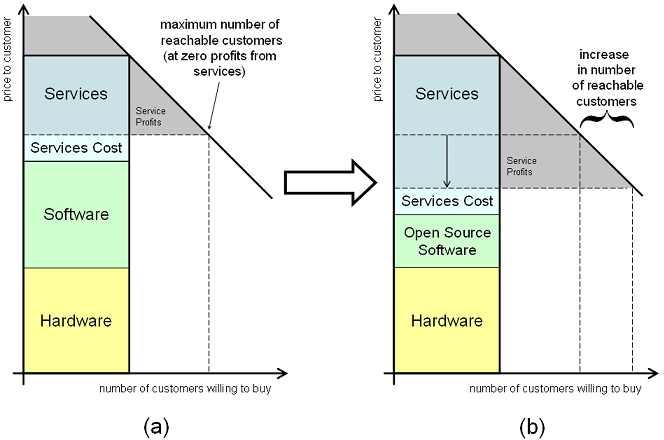
System integrators deliver solutions by selling a stack of hardware, software, and services as one product. That allows the customer to talk to one company, rather than many. Figure 1a illustrates this stack together with the customer demand curve.


Figure 1. IT solutions demand curve. (a) System integrators sell a stack of hardware, software, and services. (b) Integrators can charge customers similar prices even if they use open source software.

The demand curve shows how many customers are willing to buy the system integrator's solution at a given price. On the Y axis is the customer's cost to purchase a solution, and on the X axis is the number of customers who are willing to pay for that solution at the given price. The form of the demand curve varies depending on what is being sold. However, in general, the demand curve is downward sloping: The lower the price, the more customers are willing to buy.

A system integrator's profits depend on which of the stack's components it owns and which it must buy. Usually, a system integrator's stronghold is services, which puts together the hardware and software pieces to meet the customer's need. However, if the system integrator owns only the services component, it will have to pay other companies for the software and the hardware and thereby share revenue, leaving less profit for itself.

It's therefore in a system integrator's interest to acquire hardware and software as cheaply as possible. Open source software, if an option, is typically much cheaper than closed source software, hence its use increases profits for the system integrator.

Figure 1b illustrates how with stable supply and demand, more money is made in the services part of the value stack if software cost goes down.

Software cost savings aren't easily passed on to customers for two reasons: First, customers tend to care about the whole product rather than individual components; second, large system-integration projects are complex and new competition doesn't spring up easily. Thus, system integrators can maintain their prices.

While this is one good reason for system integrators to support open source software, there's another equally compelling reason for them to support and contribute to open source software.

2.2 Business growth

The simple value stack that Figure 1 illustrates suggests that system integrators charge customers only one price. In reality, the system integrator can charge varying prices for a total solution to a prospective customer's problem. Only one thing is certain: A system integrator will want to at least cover its costs.

The price charged per customer that Figure 1 shows can be split into the system integrator's service cost, plus the markup or margin needed to make a profit. If the system integrator owns just the services part of the stack, the cost for providing that service defines the lower price limit for the work. In a reasonably competitive market, the system integrator will accept deals above this limit if it has the resources.

This limit, together with the demand curve, determines the maximum number of customers the system integrator can sell to and take on, as Figure 2a illustrates.

Switching from more expensive closed source software to less expensive open source software increases the profits of a sale through the money saved on the software. It also reduces the lower price limit for possible deals and puts a new set of more price-sensitive customers within reach. Not only does open source software improve profits on the original individual sales, it also increases the total number of potential customers.

Figure 2b shows how a switch from closed source to open source software results in more potential customers. And more potential—and presumably satisfied—customers mean higher sales and profits. The total profit is represented as the area of the gray triangle under the demand curve, showing the increase in profits when moving down the curve. Since in reality a system integrator might own many of a total solution's components, including software and hardware, more customers mean more profits through these components as well.


Figure 2. Sales margins and number of customers. (a) The lower price limit determines the customers the system integrator takes on. (b) Switching from closed source software to open source software can result in more customers and higher profits.

2.3 Pressures in the IT value stack

If it were up to the system integrators, all software would be free (unless they had a major stake in a particular component). Then, all software license revenue would become services revenue. To this end, I believe that system integrators prefer community open source over commercial open source. Only community open source software prevents vendor lock-in.

Community open source ensures that prices for software support are subject to market forces rather than one owning corporation. Community open source is a strategic weapon for system integrators to squeeze out proprietary as well as commercial open source software vendors.


3. SOFTWARE VENDOR PERSPECTIVE

Independent software vendors provide only a few software products, sometimes just specializing in one. Understanding the independent software firm strategy requires comparing open source software and closed source software cost and pricing.

3.1 Software cost and pricing

Why is open source software typically much cheaper than closed source software? In a closed source business, most of the investment in new software comes from shipping the first copy. The initial investment is recouped with increasing sales. The additional cost of producing and selling another copy is small, consisting of producing another CD or allowing for another download plus providing the (frequently minimal) free support that comes with a software license.

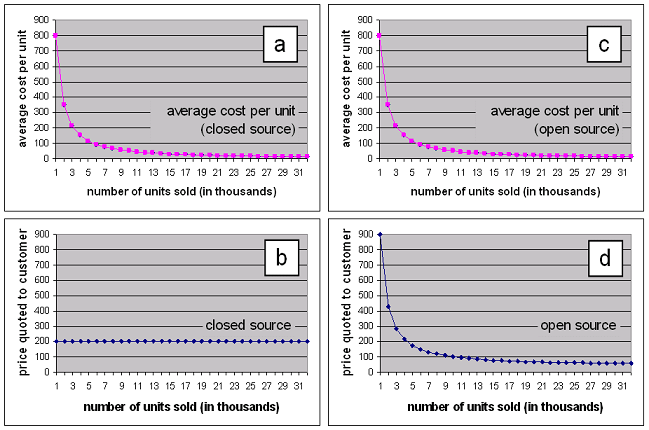
As the number of copies sold increases, the average cost per copy declines and the profits rise. Figure 3a illustrates the long-run average cost curve for a single software product.


Figure 3. Differences in cost and pricing. (a) and (c) show a similar average cost per unit for closed source and open source software, while (b) and (d) indicate the relationship between price and number of units sold for open and closed software.

The more mature a market for a specific software component, the higher the investment in the existing products, the higher the barrier to entering this market, the more established the existing players, and the more stable the price for the software component. A common scenario is "the 800-pound gorilla" firm that dominates a market and is surrounded by smaller players catering to market niches .

In such a market, the leading software vendor sets a price that maximizes its profits. Since the market is fairly transparent, the vendor can set just one pricing schedule, offering the product to different customers at the same price. (This is in contrast to the highly individual deals of large system integrators.) The result is frequently a flat price, as Figure 3b shows. Remarkably, the price of the proprietary closed source software doesn't directly depend on the actual cost incurred to develop, maintain, and provide the software.

The profit-maximizing price is largely independent of cost; the cost provides only a lower limit. Competition that drives prices closer to cost can't spring up easily due to the large initial investment a software product requires.

In a community open source situation, no such market-entry barriers exist. Given the right license, anyone can set up a company and start selling software. What the company will sell, of course, isn't the software itself, but its provision, maintenance, and support.

Because anyone can enter an attractive open source market, competition is fierce, and pricing will be based on markup over cost. If the markup is too high, new companies will enter the market; if it's too low, companies will leave the market. Moreover, the more mature the product, the lower the overall price.

Figure 3c shows the total cost of developing open source software. The total cost and the resulting average cost per copy sold is mostly the same as for the closed source solution. The main difference, of course, is that the different contributing companies now share this cost.

Figure 3d illustrates the pricing of open source software from a single firm's perspective. Because of the competition, the price charged for providing the software plus support is based on markup over cost. (The graph merging various dimensions into one 2D graph simplifies the situation, although the basic argument holds.)

Different firms will have different costs depending on their share of contributions to the open source project. However, with increasing project share, the company can charge higher prices because customers are likely to receive better service. The basic relationship remains unaffected: Price is markup over cost and varies depending on cost.

Customers love this situation because prices are substantially lower than in the closed source situation. System integrators love the situation even more because they can squeeze out proprietary closed source software.

3.2 Generating software profits

A system integrator can increase its profits if it reduces the software cost. By reducing software cost, it can move down the demand curve and sell to more customers.

Closed source software is the main obstacle to doing this: It cuts into profits on an individual sale and reduces overall pricing flexibility. Hence, system integrators have a high interest in turning closed source software markets into software markets with at least one viable community open source product.

Before the advent of open source software, entering an established and well-defended market was a risky proposition. With increasingly well-understood open source processes, setting up an open source project competing with an established closed source market leader's product is much less risky and carries a significantly higher chance of success than before. But it's not just a specific system integrator that will want to do that. It's pretty much everyone who isn't the closed source market leader.

To understand this, put yourself in the shoes of the CEO of an also-running traditional closed source company. At one point, it's becoming clear that you won't be the leading firm in your market and that your company's profits will come from market niches at best. Neither you nor your investors are happy with the projected return on investment.

Your best option now is to open source your product. You might be reducing the market's overall return on investment, but at least you'll have a second chance at satisfying your own investors by making your company a successful open source business. You'll be in good company. With a proper license for your open source product, you might well receive help from the system integrators, customers, and software vendors higher in the IT stack.

Now, assume you're the CEO of the market-leading company in some space. Thinking ahead, you have to assume that either a competitor will open source its product or that a system integrator will instigate an open source product—or both. The proactive answer to this scenario is to open source your product, even though you're the market leader and would win big in the old closed source world. But it's better to win in an open source world than not to win at all.

These two thought experiments show that community open source software has a high chance of taking new markets early on. Only strong intellectual property protection or other competitive advantages might lead a closed source company to win and keep a new market. Leaders in established markets might be able to defend their positions for a long time. They tend to dig in with complex products, established processes, customer data lock-in, and many other positional advantages. Still, open source might well prove to be disruptive enough to conquer even these markets.

3.3 Commercial Open Source

With such gloomy prospects for closed source businesses, independent software vendors have sought business models for harnessing open source software's benefits while gathering some of the profits of a closed source business. The answer is commercial open source.

The key differentiator between community open source and commercial open source is whether a community or a single entity like a corporation holds the power to make decisions about the project.

Commercial open source software is typically available for free to nonprofit users. Sometimes commercial use is free as well. Usually, companies make money by providing support services. Sometimes they make additional money by selling proprietary software enhancements.

Like community open source, commercial open source is available in source code form. Unlike community open source, however, one company controls commercial open source. This way, commercial open source software can gather some of the benefits of community open source: faster adoption, free and speedy user feedback, and possibly volunteers' code contributions. This approach is mostly a marketing strategy, however, because the company that owns the software still must do the development. Hence, the company must employ and pay the software's developers.

During the early days of an open source project, this is an advantage, as the company can provide clear direction and muster more resources than community open source projects typically can. As the project matures, this can turn into a disadvantage, as a competing community open source project might have more resources at hand in the form of volunteers.

The upside for the owning company is that little open source competition can spring up for its product. However, system integrators have a strong interest in providing alternatives to proprietary software, and this applies to commercial open source as well. Hence, this business model is likely to experience the same pressures as proprietary software.

3.4 Open source service firms

If it isn't possible to be a profitable closed source business, what does it mean to be a successful open source business? The market's answer is the open source service company, which comes in at least two kinds. One provides first-level support and implementation services; the other provides second-level support, training, and development services.

Clients of the first kind of firm are typically IT users who employ the firm's services to put the open source product into place in their IT operations. Clients of the second kind of firm typically need to get trained on the product or need to have a technical problem fixed that they can't handle themselves.

The strength of a service business usually lies in its ability to:
  • recruit and retain the right people,
  • reliably set up and execute specific service processes, and
  • bring to bear expert domain knowledge and unique intellectual property.
In the open source situation, this is usually labor economics. Technical skills around the open source product are a key part of determining an employee's value to a firm. Anyone who's smart enough can develop these skills because the open source software is available to people outside the firm.

Hiring and firing becomes easier because there's a larger labor pool to draw from, and switching costs between employees are lower compared with the closed source situation. Given the natural imbalance between employers and employees, this aspect of open source is likely to increase competition for jobs and drive down salaries. Lower salaries aren't as much of an advantage to the software vendor as might be expected because in the more transparent and competitive open source situation, such cost savings are likely to be (at least partially) passed on to customers.

3.5 The need for committers

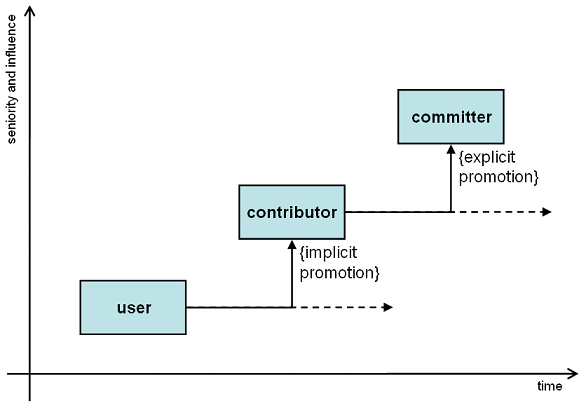
An employee's position in the open source project is another key part of his or her value to a firm. The organizational setup varies between open source projects, but in some form, people always play user, contributor, and committer roles. Users use the software, contributors contribute in some form, and committers decide what contributions to accept into the project.

Figure 4 illustrates how a developer might progress through the ranks of a community open source project: A committer typically promotes a user to a contributor role implicitly by accepting the user's contribution into the software. A contributor is typically promoted to a committer position explicitly, through a prior vote of the existing group of committers and a subsequent public announcement of the contributor's ascension to committer status.


Figure 4: Positions and promotions. In open source projects, users are implicitly promoted to contributor status, while contributors are explicitly promoted to committer status.

Committers determine where the open source project is headed, strategically and on a day-to-day basis. They can typically resolve technical problems faster than noncommitters, and have high visibility to the user community. Most projects are set up so there's only a small inner circle of committers, a larger set of contributors, and an even larger user community.

For an employer, the value of employing a committer is manifold. Through the committer, an employer

  • gets problems with the open source software fixed faster and better,
  • can better align company strategy with the open source project and vice versa,
  • appears as a more attractive employer than competitors who don't employ a committer, and
  • has higher visibility with the user community and can reach out more effectively.
A major goal of any open source service company is to convert freeloading users into paying customers. A committer's visibility with the user community is an important marketing advantage that an employer can use to support this goal.

Thus, committers have a strong negotiation position with their employers. Employing a committer is important for a first-level support and implementation services company, and it's critical for a second-level support service company.


4. THE EMPLOYEE PERSPECTIVE

Open source software and service businesses make life more complicated for employees. Employees build up less firm-specific knowledge simply because there's less of it. People from the outside can replace them more easily. At the same time, an employee's day-to-day work improves non-firm-specific knowledge of an open source project that can be taken to another employer. So a developer who is fired can find a job faster than before.

4.1 Benefits of being a committer

An employee who is a committer is likely to earn higher compensation. Hann and colleagues have empirically verified this for committers to Apache Software Foundation projects.

At any time, the committer-employee can credibly threaten to leave the company, taking significant power and reputation away from the current employer. Employers often pay premium salaries just to employ prominent committers.

But how do you become a committer? Community open source projects tend to be meritocracies, judging developers by their social and technical contributions. In contrast, a company owning some commercial open source gives committer status to its employees (and takes it away) as it sees fit.

Consequently, it makes little sense for the economically rational software developer to invest time in commercial open source. The value these developers create is tied to the product and the owning company. Unless the product is in wide use or the developer wants to work only for this one company, it makes more sense to invest time in a community open source project.

4.2 How to become a committer

Developers who start projects immediately become committers. However, they now face the task of creating a successful project out of nothing. This is a highly entrepreneurial activity: Developers must promote their project while doing the actual programming work, understanding that the outcome is uncertain.

It's more common to join an existing open source project. Assuming a fair and transparent promotion process, the two main criteria that will get a developer promoted from contributor to committer are:
  • the developer's social and technical abilities, and
  • demonstrated commitment to the open source project.
This is what most project Web sites state and what developer surveys have revealed. However, these surveys rely on what developers say they do, and actual behavior could vary from what people believe motivates them.

Because being a committer can have clear financial benefits, keeping the group of committers small is in the economic interest of a committer to a successful project. Not doing so would dilute the committer's value to current and future employers. At least this would be an economically rational person's train of thought.

Counteracting the existing committers' economic interests is the need and desire to build a working community. Also, the participants in a new project are likely to appreciate every helping hand while a mature project might not need any additional committers.

Thus, the following forces possibly influence a developer's promotion:
  • the economic self-interest of the group of existing committers,
  • the committers' philosophical convictions on running the project, and
  • the project's need for more committers.
In many ways, investing in an open source project is like joining a startup. The earlier a developer joins, the higher the risk of the project not working out but also the more likely the ascension to committer status. The later a developer joins, the lower the risk, but also the lower the chances of becoming a committer any time soon.

The window of opportunity is small for those aspiring to achieve committer status in an important open source project. With the ongoing commercialization of open source, many current projects expect a committer to work full-time on the open source project. Otherwise, committer status wouldn't be granted. This, for example, is what the Eclipse project Web site states about its core projects (www.eclipse.org). However, a company is likely to let an employee work full-time on an open source project only if that person is already a committer; otherwise how many of the benefits of its contributions the company would reap is uncertain.

A developer who chooses the right project can gain and maintain a position that will increase salary-negotiation power and job prospects. The developer will enjoy those benefits as long as the project is of significance to potential employers.

Open source reinforces the trend toward employees becoming "free agents." Committers who rationally follow their economic interests are likely to be more loyal to the open source project than to their current employer because that's where their market value lies. That results in a more fluid job market where developers can be expected to move around more freely and more frequently than in the past.


5. CONCLUSIONS

Open source software has enabled large system integrators to increase their profits through cost savings and reach more customers due to flexible pricing. This has upset existing ecosystems and shuffled structural relationships, resulting in the emergence of firms providing consulting services to open source projects. This new breed of service firm in turn lives or dies by its ability to recruit and retain appropriate talent.

For such talent, in particular for software developers, life has become more difficult and exciting at once. Developers face new career prospects and paths, since their formal position in an open source project, in addition to their experience and capabilities, determines their value to an employer. Economically rational developers strive to become committers to high-profile open source projects to further their careers, which in turn generates more recognition, independence, and job security.

Via: dirkriehle.com

Friday, 6 November 2009

Strategic advice for war and statecraft by the Byzantine Empire

I. Avoid war by every possible means, in all possible circumstances, but always act as if war might start at any time. Train intensively and be ready for battle at all times -- but do not be eager to fight. The highest purpose of combat readiness is to reduce the probability of having to fight.

II. Gather intelligence on the enemy and his mentality, and monitor his actions continuously. Efforts to do so by all possible means might not be very productive, but they are seldom wasted.

III. Campaign vigorously, both offensively and defensively, but avoid battles, especially large-scale battles, except in very favorable circumstances. Don't think like the Romans, who viewed persuasion as just an adjunct to force. Instead, employ force in the smallest possible doses to help persuade the persuadable and harm those not yet amenable to persuasion.

IV. Replace the battle of attrition and occupation of countries with maneuver warfare -- lightning strikes and offensive raids to disrupt enemies, followed by rapid withdrawals. The object is not to destroy your enemies, because they can become tomorrow's allies. A multiplicity of enemies can be less of a threat than just one, so long as they can be persuaded to attack one another.

V. Strive to end wars successfully by recruiting allies to change the balance of power. Diplomacy is even more important during war than peace. Reject, as the Byzantines did, the foolish aphorism that when the guns speak, diplomats fall silent. The most useful allies are those nearest to the enemy, for they know how best to fight his forces.

VI. Subversion is the cheapest path to victory. So cheap, in fact, as compared with the costs and risks of battle, that it must always be attempted, even with the most seemingly irreconcilable enemies. Remember: Even religious fanatics can be bribed, as the Byzantines were some of the first to discover, because zealots can be quite creative in inventing religious justifications for betraying their own cause ("since the ultimate victory of Islam is inevitable anyway …").

VII. When diplomacy and subversion are not enough and fighting is unavoidable, use methods and tactics that exploit enemy weaknesses, avoid consuming combat forces, and patiently whittle down the enemy's strength. This might require much time. But there is no urgency because as soon as one enemy is no more, another will surely take his place. All is constantly changing as rulers and nations rise and fall. Only the empire is eternal -- if, that is, it does not exhaust itself.

Via: garry’s subposterous

Thursday, 30 July 2009

i 7 principi della complessità

1) Auto-organizzazione: il principio postula la comparsa spontanea di ordine in sistemi con un’organizzazione chiusa ma aperti comunque verso l’esterno.

L’esempio classico è uno stormo di uccelli che vola in formazione, sul web invece possiamo applicare il principio ai motori di ricerca “umani” come Wikipedia o Yahoo Answer dove gli utenti, all’interno di un sito chiuso, sulla base di semplici regole si danno un’organizzazione che crea qualcosa di molto articolato sebbene di fatto spontaneo.

2) Orlo del caos: tutti i sistemi viventi evolvono quando si trovano in uno stato di confine tra il caos e l’ordine, troppo caos provoca la disintegrazione, troppo ordine la fossilizzazione.

Per il web 2.0 il ragionamento non può essere diverso: se un sito o una tecnologia non consente nessuna variazione e sperimentazione agli utenti presto muore, così come un sistema senza nessun tipo di regola è destinato a disintegrarsi.

Per questo ad esempio esistono le API o i codici sorgenti dell’open source, che consentono di spingersi sempre più avanti ma che sono gestiti da gruppi più o meno ampi quando devono essere messe a disposizione di tutti in modo da applicare solo quelle novità che portano un reale beneficio e da indirizzare il lavoro verso le soluzioni davvero utili.

3) Principio ologrammatico: il tutto è in una parte, la parte è nel tutto. Ciò è quanto mai vero nei social network e nei siti che consentono di condividere informazioni o file, dove il contributo individuale (ad es. una voce in Wikipedia) acquista piena importanza solo all’interno della community e dove allo stesso tempo il sito contenitore ha senso e funziona solo grazie a tutte le piccole parti che lo compongono e che appaiono all’esterno come un insieme unico.

4) Impossibilità della previsione: sembra anche qui chiaro che in un contesto dove sono gli utenti a creare la maggior parte dei contenuti e del valore aggiunto è di fatto impossibile prevedere tutti gli usi del servizio che si va erogando.

Per fare un esempio concreto, nel progettare un social network si possono prevedere una serie di funzioni ma poi bisogna essere pronti a capire e gestire tutti gli usi imprevisti dello strumento che gli utenti adottano e che possono diventare poi la killer application dell’intero sistema, imprevedibile finché le persone non iniziano a interagire fra loro.

5) Potere delle connessioni: il tutto è maggiore della somma delle sue parti.

Nel Web 2.0 questo è particolarmente vero dato che le relazioni e gli interscambi che le persone attuano fra loro portano ad un risultato finale superiore ad un’addizione dei singoli contributi.
Una cosa vera per tutte le relazioni ma che sul web, grazie all’enorme bacino disponibile e all’aiuto della tecnologia, porta ad un’accelerazione notevole del fenomeno.

6) Causalità circolare: nei sistemi complessi la causa genera l’effetto che retroagisce di nuovo sulla causa in modo circolare.

Per quanto riguarda il web possiamo individuare questa situazione in qualsiasi nuovo servizio a carattere relazionale dove la tecnologia genera degli usi sociale del mezzo comportando delle modifiche della tecnologia che di nuovo agiscono sui modi d’uso in processo circolare.

7) Apprendimento try&learn: in un contesto complesso l’unico modo di apprendere è quello che procede per tentativi.

In un mondo dinamico come quello dell’online moderno gli stessi professionisti del settore si trovano continuamente davanti a sfide e comportamenti che impongono un modo di procedere fatto di prove, che in combinazione con gli altri principi portano alla continua e veloce evoluzione di Internet.

Via: Internet Manager Blog

Monday, 27 July 2009

Come fare soldi gratis

Internet è una macchina gigantesca che sforna copie con un clic e gratuitamente. Per questo le cose impossibili da copiare sono sempre più rare e preziose, scrive Kevin Kelly.

Internet è una fotocopiatrice. Copia ogni azione, ogni caratteristica e ogni pensiero nel momento esatto in cui ci colleghiamo. Per spedire un messaggio da un punto all'altro della rete, il sistema di comunicazione lo copia più volte durante il percorso. Ogni singolo dato prodotto da ogni computer viene copiato da qualche altra parte.

A differenza delle riproduzioni di massa del passato, queste copie non sono semplicemente a buon mercato: sono gratis. Anzi, circolano con tale libertà che potremmo quasi pensare a internet come a un sistema di superdistribuzione in cui le copie scorrono all'infinito, come l'elettricità in un superconduttore. E soprattutto non spariscono mai.

Anche i sassi sanno che nulla può essere cancellato una volta che finisce su internet. Oggi l'economia si basa su questo sistema di superdistribuzione: la nostra ricchezza poggia su una gigantesca macchina che sforna copie in modo promiscuo e continuo.

In passato, però, l'economia si basava sulla vendita di copie che avevano un valore preciso. Quindi la libera circolazione di copie gratuite può mettere a repentaglio l'ordine costituito. Ma come si fa a guadagnare vendendo copie gratuite? La mia risposta è che quando le copie sono troppe, diventano inutili.

E quello che non si può copiare diventa raro e prezioso. Quando le copie sono gratis, bisogna vendere qualcosa che non si può copiare. La fiducia, per esempio, non si può copiare né comprare. Bisogna guadagnarsela con il tempo. Non si può scaricare da internet o falsificare, almeno per il momento.

Quindi, in un mondo saturo di copie, la fiducia è una qualità intangibile che ha un grande valore. Ci sono altri valori difficili da copiare, e quindi preziosi. Il modo migliore di esaminarli è partire non dal punto di vista del produttore, del costruttore o dell'autore, ma da quello dell'utente. Cominciamo con una semplice domanda: perché dovremmo pagare per qualcosa che possiamo avere gratis?

Ho individuato circa otto categorie di valori che non si possono copiare. Io li chiamo "generativi": un valore generativo è una qualità che va generata, fatta crescere e coltivata. Non si può copiare, clonare, falsificare o replicare. Viene prodotta una volta sola, in un posto e in un momento preciso. Nell'arena digitale, le qualità generative aggiungono valore alle copie gratuite. Dunque si possono vendere.

1) Immediatezza. Prima o poi tutti potremo procurarci una copia gratuita di qualunque cosa, ma riceverla nel momento esatto in cui è stata prodotta è un valore generativo. Molte persone vanno al cinema la sera della prima, e pagano un biglietto per vedere un film che poco dopo sarà disponibile in rete praticamente gratis. Anche la prima edizione di un libro o il primo esemplare della serie spesso giustificano un prezzo extra. Come qualità vendibile, l'immediatezza si articola su più livelli, a cominciare dall'accesso alle versioni beta. I fan qui vengono coinvolti nello stesso processo generativo. Spesso diamo poco valore alle versioni beta perché sono incomplete, però hanno delle qualità che è possibile vendere. L'immediatezza è un termine relativo, e deve adattarsi sia al prodotto sia al pubblico. Un blog ha un significato temporale diverso da quello di un film o di un'automobile. Ma l'immediatezza si può trovare in qualsiasi prodotto.

2) Personalizzazione. In rete possiamo scaricare un concerto gratis, ma forse saremmo disposti a pagare per avere una versione che suoni perfettamente nel nostro salotto, come se l'avessero registrata proprio lì. Allo stesso modo, la copia gratuita di un libro può essere personalizzata dall'editore in modo da seguire i gusti del lettore, oppure un film può essere montato in modo da rispecchiare le preferenze dello spettatore (niente violenza, ma le parolacce vanno bene). L'aspirina è quasi gratis, ma un'aspirina fatta su misura secondo il dna del paziente potrebbe costare parecchio. La personalizzazione richiede uno scambio continuo tra autore e consumatore: per questo è impossibile da copiare.

3) Interpretazione. C'è una battuta che dice: il software è gratis, il manuale costa diecimila dollari. Ma alcune aziende famose si guadagnano da vivere proprio così: offrono assistenza a pagamento per software gratuiti. Credo che molte informazioni genetiche seguiranno la stessa strada: avere la copia del proprio dna oggi costa caro, ma presto le aziende farmaceutiche pagheranno per avere la vostra sequenza genetica. La copia della sequenza sarà gratis, ma sapere interpretarla e usarla – cioè avere il suo manuale genetico – costerà parecchio.

4) Autenticità. Potete anche scaricare un software senza pagarlo, ma anche se non avete bisogno di un manuale dovrete assicurarvi che il programma sia affidabile e a prova di bug. L'autenticità si paga. In rete si trovano molte registrazioni dei Grateful Dead, ma se comprate una canzone direttamente dalla band sarete sicuri che è proprio quella che stavate cercando. I pittori affrontano questo problema da molto tempo e spesso le litografie e le foto hanno un marchio di autenticità dell'artista, che fa salire il prezzo della copia. La filigrana digitale e altre tecnologie per l'autenticazione non riescono a impedire la riproduzione ma assicurano che la copia è autentica.

5) Accessibilità. La proprietà è quasi sempre una gran rottura di scatole: bisogna tenere le cose in ordine, aggiornarle e fare sempre una copia di backup. E in questo mondo mobile, bisogna anche portarsele dietro. Molti, me compreso, sarebbero più che felici di gestire le proprie cose attraverso un abbonamento: pagherei una società per avere accesso a ogni brano digitale esistente, film, libro o foto, quando e dove voglio. Loro faranno una copia di backup di tutto, pagheranno gli autori e mi daranno quello che desidero sul telefono, sul palmare, sul portatile o attraverso un megaschermo, ovunque mi trovi.

6) Corporeità. La copia digitale è incorporea: posso prendere la copia gratuita di un lavoro e trasferirla in un attimo sul mio schermo. Forse però mi piacerebbe guardarla in alta risoluzione su uno schermo gigante o magari in 3D. Il pdf non è male, ma a volte è meraviglioso poter leggere le stesse parole su carta bianca morbida, rivestita di pelle. E che dire di una bella partita al nostro gioco (gratuito) preferito con altre 35 persone, tutti nella stessa stanza? Certo, l'alta risoluzione di oggi – quella che ci spinge ad acquistare un biglietto e a fare la fila al cinema – in futuro la troveremo sugli home theater.

Ma ci saranno sempre delle tecnologie di trasmissione video eccezionali che i consumatori non avranno mai. Proiezioni laser, rappresentazioni olografiche, il ponte ologrammi di Star Trek! E, ancora, non c'è niente di più corporeo della musica durante un concerto dal vivo, con i musicisti in carne e ossa. La musica è gratis, il concerto costa. Questa formula sta diventando sempre più comune anche tra gli scrittori: il libro è gratis, andare a una presentazione dell'autore si paga.

7) Mecenatismo. Sono convinto che, in realtà, il pubblico voglia pagare gli autori. Ai fan piace ricompensare gli artisti, i musicisti e gli scrittori perché così entrano in contatto con i loro idoli. Ma sono disposti a pagare solo se il processo è molto semplice, se la somma è ragionevole e se hanno la certezza che i soldi finiranno direttamente nelle tasche degli autori. L'ultimo esperimento dei Radiohead è un esempio perfetto: per scaricare il loro ultimo album potete pagare la cifra che vi sembra più giusta. Il sottile legame che unisce i fan e l'artista ha un valore. Nel caso dei Radiohead questo valore è di circa 5 dollari a down load.

8) Reperibilità. Non è una caratteristica delle singole opere, ma un valore legato all'insieme in cui sono raccolte. Un costo zero non contribuisce ad attirare l'attenzione su un'opera. Anzi, a volte può essere controproducente. Ma a prescindere dal prezzo, un'opera non ha valore se non è visibile: un capolavoro nascosto non vale niente. Quando ci sono milioni di libri, di canzoni, di film, di cose (spesso gratis) che richiedono la nostra attenzione, trovare quello che stiamo cercando diventa fondamentale.

I grandi aggregatori come Amazon e Netflix hanno successo perché aiutano le persone a trovare quello che gli piace di più. Sfruttano la teoria della "coda lunga", che mette in contatto il pubblico di nicchia con gli autori di nicchia. Purtroppo, però, la coda lunga fa bene soprattutto agli aggregatori più grandi, come gli editori, gli studios e le etichette discografiche. Ma dato che per essere reperibili bisogna far parte di un sistema, gli autori hanno bisogno degli aggregatori.

Ecco perché gli editori, gli studios e le etichette discografiche non spariranno mai. Non servono alla distribuzione delle copie (per quello c'è già internet), ma indirizzano l'attenzione delle persone verso le opere.

Partendo da un oceano infinito di possibilità, le case discografiche hanno il compito di trovare e coltivare il lavoro di quegli artisti che, secondo loro, hanno più possibilità di avere successo. Ci sono poi altri mediatori, come i critici e i recensori, che contribuiscono a orientare l'attenzione del pubblico.

I fan si affidano a questa rete di reperibilità per scoprire le cose più interessanti tra i milioni di opere prodotte ogni giorno. Si possono fare molti soldi scoprendo talenti: il settimanale Tv Guide ha guadagnato per anni più dei canali tv di cui consigliava i programmi.

Questi otto valori richiedono delle nuove competenze. Nell'era della copia gratuita il successo non dipende dalle capacità di distribuzione: per quello c'è la "grande fotocopiatrice". Non servono neanche le conoscenze legali sulla proprietà intellettuale e il diritto d'autore.

Al contrario, le otto qualità generative richiedono una nuova consapevolezza: che l'abbondanza alimenta la condivisione, la generosità è un modello di business e oggi è fondamentale coltivare e far crescere tutto ciò che non si può replicare con un clic. Il denaro, nell'economia della rete, non segue la strada della copia. Segue la strada dell'attenzione e l'attenzione ha i suoi circuiti.

I lettori più attenti avranno notato che non ho parlato della pubblicità, che spesso è considerata l'unico modo per avere tutto gratis.

Molte delle soluzioni che ho proposto richiedono una qualche forma di pubblicità, ma credo che in futuro sarà solo uno dei tanti modi per fare soldi vendendo ciò che è gratis. Ma questa è un'altra storia.

Friday, 24 July 2009

Family Business Management and the Drucker's Rules

INTRODUCTION: THE FAMILY BUSINESS IN PERSPECTIVE
Of the 13.2 million businesses in the United States, 90 percent are family owned and managed. These companies employ more than 77 million people, or about six out of every 10 workers in the United States, pay 65 percent of all wages, and generate 55 percent of the nation s gross domestic product. Between 1977 and 1990, family businesses created eight out of every 10 new jobs in the United States.

Not All Family Businesses Are Small
Contrary to popular belief, not all family businesses are small like the husband-and-wife team running the local restaurant. About 200 of the Fortune 500 companies are family owned. There are also large Chinese family-owned businesses. As an example, 40 percent of the Hong Kongs market capitalization is controlled by 15 Chinese family groups. In Taiwan, 16 of the top 20 companies in terms of total assets are family-owned and family controlled. In Indonesia, nine out of the top 10 businesses are owned by Chinese families, and in Thailand, Chinese families own four of the countrys largest banks.

Family Business and Size
According to Drucker," There is little doubt that beyond a certain size, a business can no longer reserve management to family members and remain viable. Beyond a certain size, that management burden increasingly has to be borne by professional managers."

This article presents Drucker s Rules for family business management and the role of the family and non-family professional managers in the family business. The Chinese family business may differ considerably from family businesses found in the West, and the Chinese family business owner will have to determine which, if any, of Druckers Rules apply.

DRUCKER'S RULES
Functional vs. Management Work
There is really no difference, says Drucker, between professional management and family-managed businesses when it comes to functional work research, marketing or accounting. On the other hand, when it comes to management of the family business, different rules are required. Without them, the family business will not survive or prosper.

Rules for Family Members in the Business
Family members should not be allowed to work in the family business unless they are as capable as non-family employees. They should only be allowed to stay in the business if they qualify on merit, not because they are family members.

Respect is a critical dimension of the family member working in the business. If the family member does not command professional respect, they should not be in the company. Dr. Swaim sights a case: the son of a founder was CEO of the company, but did not enjoy the respect of the non-family professional management team marketing, finance, operations, and managers. The lack of direction hurt morale and the company performance waned. Dr. Swaim arranged for a management buyout of the son and the company is now doing very well managed by non-family professional managers. The major issue: Lack of respect.

A family member who is not willing to work, no matter what their educational background and capabilities, should not be allowed in the family business. Also, if the family member is not of top-management caliber, with the potential to take over leadership of the company, they should actually be paid a stipend to stay away from the business. Some analysts also suggest that family members not be allowed into entry level positions. Ideally, they should have spent several years gaining practical experience working in another business before joining the family firm.

With respect to promotions, family members should never be given preference if there is a more qualified and better performing non-family member in management. Finally, over time, family members will elect not to enter the business and the company will eventually become totally professionally managed by non-family members.

Rules for Non-Family Managers
The non-family members in top management should be given rewards and incentives that make them feel like owners or as Drucker says, they need full citizenship in the firm. After all, it is their commitment to the family business that allows the business to grow and continue to be successful. These rewards can be stock options, stock bonus plans, phantom stock or other creative incentives to retain the commitment and motivation of a non-family manager. Without these incentives, there is danger the non-family manager or managers will become frustrated, elect to start their own business and end up becoming a competitor. With respect to top management, Drucker suggests at least one senior management position always be filled by a non-family professional manager such as the COO, finance manager or marketing manager. For a humorous example, Drucker cites the Mafia, where the second in command to the Godfather , the consigliore, is not a member of the family and may not even be a Sicilian.

Unless the family business is small, key staff positions should also be filled by non-family members research, marketing, finance and human resources management. Family members cannot have all the knowledge and expertise required for all of these areas.

Another important rule for the non-family manager is: Dont mix business with family. If the non-family manager attempts to become too close to the family, there is a danger of losing perspective on the business. Therefore, the non-family manager should generally avoid family social gatherings unless it is a special event to which he or she has been invited. Summer barbecues, for example, do not qualify as such a special event.

Succession Planning
Who will take over the leadership of the family business is a critical decision. It shouldn t be left until the day after the founder dies. Drucker advises this decision be trusted to an outside advisor who is neither part of the family, nor part of the business. We will deal with succession planning and family business exit strategies in more detail in part two of this article in next months edition.

Summary and Plan for Change
The family business needs to plan for its eventual change in character. Drucker estimates that after two generations, the family will only be the beneficiaries of the business, not the bosses. As an example, studies have shown that 80 percent of family businesses never get to the second generation.

Finally, opportunities for family members should be available to those who are able and desire to pursue a career in the business. On the other hand, those who do not fit these requirements should stay out of the business and remain investors.


--------------------
Research on Owners of Private Businesses
Several years ago, a leading accounting and consulting firm conducted a study of owners of private and family-owned businesses and discovered the following.

They don t know the businesss value: 65 percent of business owners do not know what their company is worth. In other words, they are unaware of the fair market value of their business and what they could get for the business if selling the business is an exit strategy alternative they might consider. Knowing the value of the business is also important if the owner is considering other exit strategy alternatives, such as passing the business on to family members.
They have no exit strategy or succession plan: 85 percent of business owners have no exit strategy or succession plan. The owner has not given any consideration to how or when they will eventually retire and who will take over the management of the business. This is often attributed to their reluctance to accept their own mortality they will live forever, and the fact that their personal identity is intertwined with the business they lose their identity if and when they leave their business. Also, many owners are unable to give up their baby, similar to the father s concerns when their daughter gets married and he must give the bride away at the wedding ceremony.
The majority of the owners net worth is in the business: 75 percent of the business owners net worth is tied up in their business. There is a prudent rule that suggests that not more than 20 percent of an individual s personal wealth should be tied up in any one investment. Obviously, most business owners have disregarded this rule. Having equity in the business is all well and good, but how does one convert this into cash for ones retirement?
They have no personal financial and estate planning: 25 percent of senior generation owners have not done any estate planning to minimize their taxes or worked out how to convert the equity they have in their businesses into personal wealth and liquidity. It is one thing to pass the family business on to a son or daughter, but in so doing, how does the father get compensated for the work he put into starting and growing the business over the years?


Six Exit Strategies
"You develop an exit strategy the day you start the business."

-Richard Rodnick,

founder, former chairman, Geneva Companies

Richard Rodnick, founder and former chairman of Geneva Companies, a merger and acquisition firm in the United States, has a rule that the time to develop an exit strategy is the day you start the business.

As an example of practicing this rule, Rodnick had an exit strategy that he would sell Geneva Companies five years after he started it. He sold the company to the Chemical Bank of New York for in excess of $30 million.

Some would argue that this rule does not allow the owner to get full value for the company-that if he held on to the company for several more years, he might get considerably more money for the business.

To counter this argument, there is another interesting quotation. When Bernard Baruch, an individual who amassed a personal fortune in the mid 1900s was asked how he became so wealthy? he replied," I always sold too soon."

Drucker also stresses that succession planning should not be left to the last minute, such as right after the owner-founder passes away and was buried yesterday. Therefore, let us briefly review the various exit strategies available to the business owner and then deal with succession planning as part on of the exit strategy alternatives.

Six Exit Strategy Alternatives
There are six main exit strategy alternatives available to the business owner to consider, excluding liquidation of the business. The first five deal with strategies to consider when there are no family members qualified or interested in taking over the management of the business, and the last strategy deals with succession planning where there are family members who potentially could take over. Actually, there are situations in the first five strategies where family members may still continue to manage the day-to-day operations of the company, but will no longer have a significant percentage of its ownership.

1. Selling to outsiders
This exit strategy involves selling the business to outsiders through a direct sale or possibly a merger where the other party gains a majority interest in the new business combination. Although it may be called a merger, usually for the owners ego we merged with the multinational giant 100 times our size most of these transactions are actually acquisitions.

Selling a privately owned business is more complicated then it may seem and the process of selling a business is too lengthy to include in this article. For additional insight on mergers and acquisitions, check out Drucker on mergers and acquisition in Business Beijing of March 2002 Issue 68.

2. Sell to insiders management, employees
Selling the business to its non-family member management and employees is another strategy usually considered. Oftentimes, management may be disenchanted with the lack of direction in the company when the owner-founder loses his energy and enthusiasm for growing the business. The owner-founder continues to lead a good life in terms of his or her personal compensation and perks, but has become conservative and averse to taking unnecessary risks. Thus, the company ages poorly, often resulting in loss of market share.

Management may feel new leadership can turn the situation around. The problem with considering this exit strategy however, is how will management and employees raise the financing required to acquire the business? Passing the hat around, so to speak, and asking management and the employees to contribute some of their personal savings to acquire the company generally will not even raise enough money for a downpayment on the acquisition.

3. Selling to a partner or other shareholders
If the owner-founder has other partners or shareholders he might consider selling his interest in the business. Two issues arise here that need to be dealt with to implement this strategy. First, what is the value of the shares to be sold and do all shareholders agree on the value? This typically can be resolved by using an outside professional business valuation firm to establish the fair market value of the business and value of the shares. Second, as in the case of selling to management and employees, how will the other shareholders raise the financing to acquire the owner-founders shares? Agreeing to be paid out of future profits is a typical method. However, this leaves the owner-founder at considerable risk if the new management makes poor business decisions. Ideally, the shareholders should borrow the money to cash out the owner-founder and repay the lending institution from the future profits of the business.

4. Sales to equity funds, private investor groups
Equity Funds and Private Investment Groups (PIGs) can be an attractive exit strategy. In fact, this is one of the best strategies to consider. In investment banking industry terminology, this is called a re-capitalization or recap. Equity Funds and PIGs typically invest in a portfolio of businesses that meet their investment criteria (type of business, industry, geographic location, size in revenues) and will usually acquire a 60-80 percent ownership percentage, sometimes higher, in the business.

One of the major criteria of Equity Funds and PIGs is that there must be a strong management team in place in the business as they are typically not interested in running the day-to-day operations of the business, but only in providing strategic direction at the board level. There should also be a certain degree of synergy with their existing portfolio of businesses such as same or related industry, market served, technology used.

If there are family members who are capable of, and interested in managing the business, this is an excellent way to meet the personal and business objectives of the owner-founder by allowing him to receive a significant payment while management and the remaining percentage of ownership in the business can be transferred to the next generation.

5. Selling to the public: Initial Public Offering
Although there are some very large family businesses as mentioned in Part One of this article, the typical family owned business is generally too small to seriously consider an IPO as an exit strategy alternative. We will not discuss the IPO in detail other than to mention it is a time consuming and expensive process.

6. Transfer ownership to other family members-the succession plan
Succession planning is essential to ensure the future continuity of management of the business, particularly if there are other family members interested in, and capable of managing the business.

The quotation at the beginning of this article illustrates the importance succession planning has on the future of the business The average life expectancy of the family business is 25 years.

Succession planning when there is single heir, son or daughter, is the least complicated model, if he or she desires to enter the business, and has the ability to eventually run the business. The models get more complicated when there are multiple heirs, older vs. younger children, sons vs. daughters, inactive family members, the spouse of the dead owner-founder, a second spouse, a son-in-law, and unrelated (non-family member) successors.

In the case where there are multiple heirs, succession planning should involve two entities in the planning process: a family council and an outside advisor. The role of the family council is to first define the responsibilities and qualifications required for the successor in terms of knowledge, skills and experience. Some suggest the following criteria be considered when identifying potential successors:

3-5 years employment in a job or jobs that have depended on competence, skill, and sustained performance, rather than on family-based relationships. Many also suggest that this experience should have been gained outside of the family business.

Experience in directing the activities of others.
Recognition for proven competence on the job.
Evidence and ability to manage relationships, both with peers and with supervisors.
Evidence of the ability and willingness to take initiative on the job.
Evidence of having been a valued employee with legitimate contributions to make.
The next step for the family council is to then identify possible successors, either family members or non-family professional managers, but not to make the selection themselves.

This should be left, as Drucker suggests, to an outside, non-family advisor who can provide an objective perspective and eliminate the chance of potential conflict among the family members. As part of the selection process, it is also important to make it clear to everyone involved that they are not required to join the family business.

With respect to the spouse eventually becoming a successor if the owner-founder passes away, this depends on how much involvement she or he had in the business prior to the death. If there is another business partner, or business partners, they may not want the spouse involved in the business.

This potential problem can be resolved with a buy-sell agreement established between the partners at the time of the formation of the business outlining how a partner s share in the business can be purchased in the future.

Once the successor has been identified, it is important to have a developmental plan for the individual to gain the necessary knowledge and experience to take over the management of the business. The extent of the developmental plan will obviously vary depending on the age and experience of the potential successor.

The son or daughter entering the business after working elsewhere in their first job will require considerable more development as compared to a non-family professional manager who is already performing in a key management position as suggested by Drucker in our first article.

Summary
The first article outlined Druckers Rules for managing and growing the family business and this part with how to ensure continuity through succession planning.

Various exit strategies available to the owner-founder when there are no apparent family members interested in eventually managing the business were briefly discussed.

We conclude with Drucker s two key points relative to succession planning and exit strategies don t leave this important task until the last minute, and use objective, non-family advisors to assist in the selection process. Finally, no attempt was made to compare how the concepts presented in these articles relate or do not relate to Chinese family businesses. Although we feel many of these concepts would relate, history, tradition, and culture would most likely and unfortunately, cause these concepts to fall on deaf ears.

Related Posts with Thumbnails